Last week I referred to the fact that more spending doesn’t always equal a better result.
In other words the benefit for rising spending won’t always look like this:
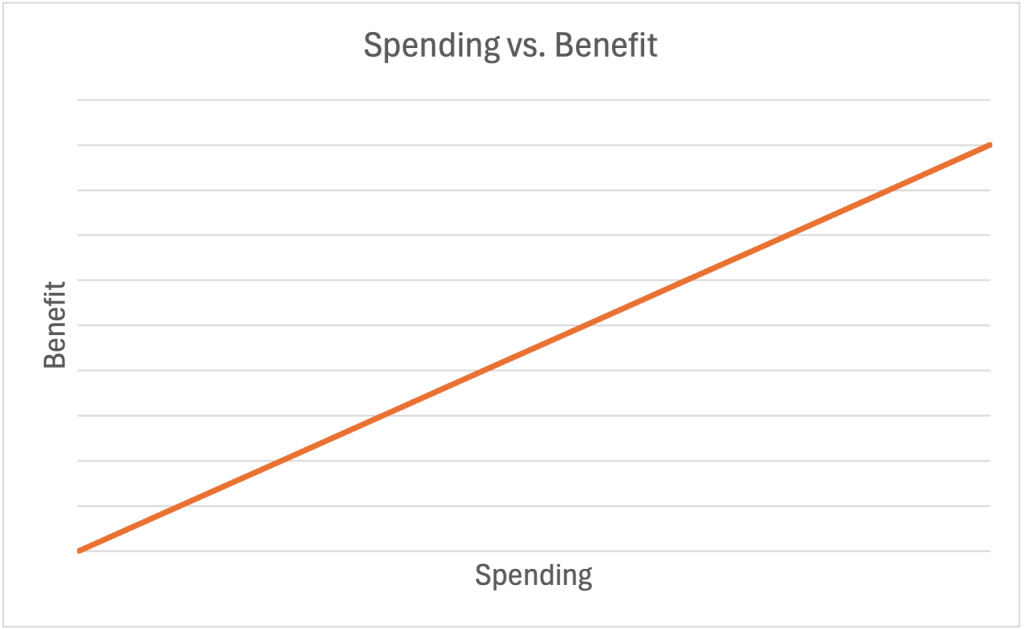
Sometimes it will look like this:

In this case, the first unit of spending brings a large result, the second a smaller, and so on until there is actually a negative result for increased spending.
Is this a total fanciful idea, that increased spending can bring a negative result?
Well, I am not sure that this example would exactly follow a bell shaped curve, but hydration comes to mind. The difference between no water and one glass of water per day is huge in terms of physical effect. Two glasses of water per day is going to be better than one, but the increased benefit to health will be less than the difference between no water and one glass per day.
It is my understanding that at one point too much water can cause health issues, even death.
However, there is an amount of water consumption where neither less nor more is beneficial. This is the idea of a golden mean. That is, there is a just right amount that Goldilocks would approve of.
Thankfully, for where I live, the cost for potable water is very affordable, so staying properly hydrated is more of a habit to maintain than making sure my budget can cover this expense.
The takeaway for me, then, is that as I am reviewing my expenditures using hledger, I need to ask if there is a “just right amount” of spending for a category. That is, what is the amount of spending where I can’t get any more benefit from spending more?
What if the “just right” amount is beyond my budget? That’s OK. The idea here isn’t that you want to maximize the good in every possible spending category in your life. The idea is that you don’t want your spending to pass the point of maximum value.
Next week I plan to look some more at this. Stay tuned.